
Motocross The Game Time Attack: Climb the Boards
A complete time attack guide for Motocross The Game: how the per-track, per-class leaderboards work, how to set a clean lap and how to climb the global board.
Time attack in Motocross The Game is a solo lap against a global leaderboard for each track and bike class, ranked to the millisecond. Warm up, run three clean laps, then fix the corner where you lose the most time. Do not chase the record until your average lap is consistent.
Time attack is the purest mode in Motocross The Game. There is no traffic, no first-corner chaos and no one to blame. Just you, the bike, the track and a clock that measures to the millisecond.
The official description says every time attack track has a live global leaderboard per bike class, also visible on the game's website. That makes time attack more than a solo mode; it is a public scoreboard that other riders can study.
How the leaderboards work
The boards are split by track and bike class. A 250F lap does not compete with a 450F lap. That is important: the two classes have different power delivery, different gearing and different lines.
The boards are ranked to the millisecond. A lap that is 0.001 seconds slower is still slower. At the top of the board, the gaps are tiny because the fastest riders are extracting the same speed from the same physics.
The official site also publishes a career leaderboard with world records, podiums, pace index and clean runs. That gives you a second way to measure progress beyond a single track.
What makes a good time attack lap
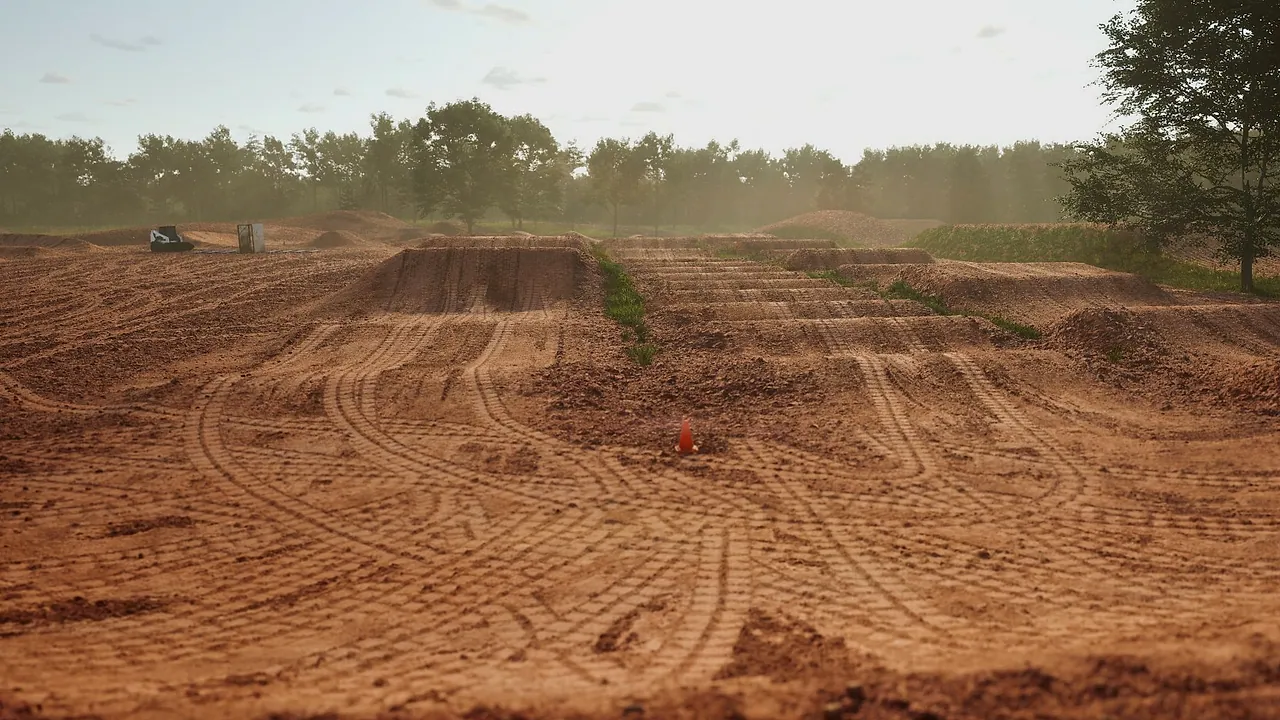
A fast lap is not one heroic corner. It is a series of clean corners, each with a good entry, a good line and a good exit. The rider who wins the board is usually the rider who makes the fewest mistakes, not the rider who takes the most risks.
Three habits matter:
Consistency. A rider who runs ten laps within 0.2 seconds can find the last tenth. A rider who runs one fast lap and nine messy laps cannot.
Vision. Look two corners ahead. The bike follows your eyes.
Patience. Do not force a lap. If you make a mistake in the first sector, finish the lap as a practice lap and reset.
The three-lap method
Do not run twenty laps and hope one is fast. Use a structured set:
- One warm-up lap at 80 percent. Get the tyres, the brakes and your eyes up to speed.
- Three timed laps at 95 percent. Focus on one sector per lap.
- One cool-down lap. Review what you learned.
Then stop and think. Where did you lose time? What was the cause? What will you change?
This method produces better laps than endless grinding because it forces you to analyse.
Finding the time
Use sector times if the game shows them. If not, break the track into three parts in your head.
Sector 1: the start and first corners. This is where cold brakes and cold tyres cost time. Brake earlier on lap one.
Sector 2: the middle. This is usually the most technical part. Ruts, jumps and direction changes.
Sector 3: the finish. This is where fatigue costs time. Stay focused.
Compare your sectors to your best lap. The sector with the biggest gap is your next practice target.
Pick the corner where you lose the most time and ride it twenty times. Then move to the next.
Setup for time attack
Time attack rewards a setup that is predictable, not a setup that is fast for one lap.
Suspension. Stable and supportive. You want the bike to do the same thing every lap.
Tyre pressure. Consistent. Do not run a pressure that only works for one lap.
Gearing. Matched to the track. If you are hitting the limiter, go taller. If you are bogging, go shorter.
Assists. Turn them down one at a time. A rider with no assists is not automatically faster; a rider with the right assists can be more consistent.

Using the reference times
The official board gives you a reference for every track. When we checked on November 10, 2026:
- Midsummer Carnage 250F: 0:49.496, with 592 riders.
- Estrella MX 250F: 1:06.018, set by JGodbout.
These are snapshots, not permanent records. Use them to judge your pace, not to compare yourself to a professional.
A good target for a new rider is within 10 percent of the record. A club rider is within 5 percent. A top rider is within 2 percent.
Climbing the board
Phase 1: learn the track. Ten laps, no timing. Find the lines.
Phase 2: build consistency. Ten laps at 90 percent. Record your average.
Phase 3: find the limit. Three-lap sets. One sector per set.
Phase 4: polish. Fix the last corner. Run a final three-lap set.
Phase 5: maintain. Race online to keep your racecraft sharp, then return to time attack.
Do not skip to phase 3. A rider who cannot run consistent laps cannot improve them.
Common time attack mistakes
Grinding without analysis. Twenty laps of the same mistake teach you nothing.
Changing the setup every lap. You cannot tell what worked.
Cold tyres. Lap one is not a qualifying lap.
Forcing a lap. A mistake in sector one should end the lap.
Ignoring the board. The gap to the record tells you where you stand.
Time attack and the Dual Rating
Time attack feeds your career profile, including world records and pace index, but it does not replace online racing. The Dual Rating System is built around races. If you want a high Skill Rating, you need to race.
Use time attack to prepare for races, not to avoid them. A rider who can run a clean solo lap has the tools to run a clean race lap.
For the next step, the cornering guide→ covers the related inputs in more detail.
FAQ
Is time attack a separate mode? Yes. It is a solo mode with global leaderboards per track and bike class.
Are the leaderboards live? The official description says the boards are live and visible on the game's website.
Can I use any bike in time attack? The boards are split by bike class. Pick a class and commit to it for a fair comparison.
How often are records beaten? At launch, the boards move quickly. Check the live board for the current record.
Does time attack improve my Skill Rating? It contributes to your career profile, but the Dual Rating is primarily driven by online races.
Sources
Official source: Steam store description and official leaderboard, checked November 10, 2026. Reference times are snapshots and may change.